Surveying, How to Read Tax Map Id
A contemporary plat map used in the lot and block system.
The lot and block survey organisation is a method used in the The states and Canada to locate and identify land, particularly for lots in densely populated metropolitan areas, suburban areas and exurbs. It is sometimes referred to as the recorded plat survey system or the recorded map survey arrangement.[1]
Origins of the system [edit]
The system is the most recent of the three principal survey systems. It began to be widely employed in the United States in the 19th century when cities began to expand into the surrounding farmland. The owners of a large tract of land would create a plat and subdivide the tract into a series of smaller lots to be sold to buyers. This subdivision survey program would then be recorded with an official government record keeper. The officially recorded map then became the legal description of all the lots in the subdivision. The method became widespread after the post World War II expansion into the suburbs when formerly rural areas became heavily populated and large tracts of rural land were divided into smaller lots.
Mechanics [edit]
The system begins with a large tract of land. This large tract is typically defined by 1 of the earlier survey systems such as metes and bounds or the Public Land Survey System. A subdivision survey is conducted to divide the original tract into smaller lots and a plat map is created. Commonly this subdivision survey employs a metes and bounds arrangement to delineate individual lots within the main tract. Each lot on the plat map is assigned an identifier, ordinarily a number or letter. The plat map is then officially recorded with a regime entity such as a city engineer or a recorder of deeds. This programme becomes the legal clarification of all the lots in the subdivision. A mere reference to the individual lot and the map's identify of tape is all that is required for a proper legal description.
Understanding property descriptions [edit]
The Lot and Block system is maybe the simplest of the three main survey systems to understand. For a legal description in the Lot and Cake system a clarification must place:
- the individual lot,
- the block in which the lot is located, if applicable,
- a reference to a platted subdivision or a phase thereof,
- a reference to find the cited plat map (i.e., a folio and/or volume number), and
- a description of the map'south place of official recording (eastward.1000., recorded in the files of the County Engineer).
The legal description of a two.five-acre (x,000 grandtwo) property under the Lot and Block system may be something like; Lot v of Cake 2 of the South Subdivision plat as recorded in Map Book 21, Page 33 at the Recorder of Deeds. Some uncomplicated maps may simply incorporate a lot and map number, such equally Lot C of the Riverside Subdivision map as recorded in Map Book 12, Page 8 in the office of the City Engineer. The more technical details of the legal description are all contained in the recorded plat map and in that location is no need to reiterate them in a human action or other legal description.
By dissimilarity, a Public Land Survey System legal clarification of the same 2.5 acres (10,000 m2) belongings would be something like SW one/4 SW1/four NE1/4 SW1/4 SEC 18 T1S R1E Humboldt Meridian. The metes and bounds clarification may exist something like, Outset at a monument located at the SE corner of the belongings at present or formerly of J.West. Smith; thence north 330 anxiety to a signal; thence east 330 feet to a point; thence south 330 feet to a point, thence west 330 feet to the identify of beginning.
Other uses [edit]
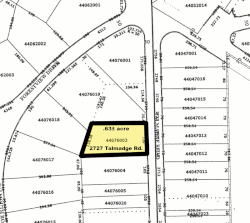
A type of the Lot and Block system is frequently used for taxation identification purposes in the United States. This designation, frequently called a Taxation Identification Number or Taxation Package Number, is not directly based on the legal description of the property.
The system can be used even if the property is non legally described by the Block and Lot system. A holding legally described by a metes and bounds description may nevertheless be assigned a Tax Identification Number based on a split up Lot and Block arrangement. In this case, a survey of all parcels in the county or municipality would be combined to create a separate Block and Lot system to identify the properties for taxation purposes. For example, a metes and premises described parcel may be assigned the Tax Identification Number xiv-55-118, which has zippo to do with the legal description of the holding recorded in the human action other than its utilise to create the revenue enhancement Cake and Lot maps. In this instance, the first number may be used to indicate the local municipality, the 2nd number indicates the tax map on which the property is recorded, and the third number is the parcel identification number on the indicated map. A similar system might be Taxation Identification Number 205-K-33 where "205" is the map book book number, "One thousand" is the individual map, and "33" is a packet number.
Encounter also [edit]
- Borough, Cake and Lot (New York City)
References [edit]
- ^ http://the states.practicallaw.com/5-507-1532
- Shelia Crowell, et al., The Appraisal of Real Estate, Chicago: The American Institute of Real Estate Appraisers, 1983. ISBN 0-911780-69-6
External links [edit]
- The U.S. National Athenaeum and Records Assistants
Source: https://en.wikipedia.org/wiki/Lot_and_block_survey_system
0 Response to "Surveying, How to Read Tax Map Id"
إرسال تعليق