Webworks Probability and Statistics for the Liberal Arts I
Learning Outcomes
- Describe a sample infinite and simple and compound events in it using standard notation
- Calculate the probability of an event using standard notation
- Calculate the probability of two independent events using standard notation
- Recognize when two events are mutually sectional
- Summate a provisional probability using standard note
Probability is the likelihood of a detail upshot or upshot happening. Statisticians and actuaries use probability to make predictions about events. An actuary that works for a car insurance visitor would, for instance, be interested in how likely a 17 year old male would be to get in a car blow. They would apply data from past events to make predictions virtually future events using the characteristics of probabilities, then use this information to summate an insurance rate.
In this section, nosotros will explore the definition of an issue, and learn how to calculate the probability of it'due south occurance. Nosotros will also practise using standard mathematical note to calculate and draw different kinds of probabilities.
Basic Concepts
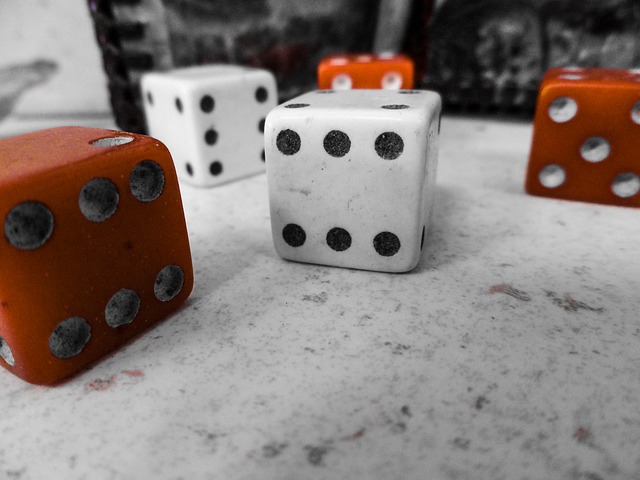
If y'all roll a die, option a bill of fare from deck of playing cards, or randomly select a person and observe their hair color, nosotros are executing an experiment or procedure. In probability, we await at the likelihood of different outcomes.
We brainstorm with some terminology.
Events and Outcomes
- The upshot of an experiment is called an result.
- An event is any particular outcome or grouping of outcomes.
- A simple event is an upshot that cannot exist broken downward further
- The sample space is the ready of all possible simple events.
example
If nosotros curl a standard six-sided dice, describe the sample infinite and some elementary events.
Bones Probability
Given that all outcomes are as likely, we tin can compute the probability of an upshot East using this formula:
[latex]P(East)=\frac{\text{Number of outcomes corresponding to the event E}}{\text{Total number of equally-likely outcomes}}[/latex]
examples
If we roll a 6-sided dice, calculate
- P(rolling a i)
- P(rolling a number bigger than iv)
This video describes this case and the previous one in detail.
Let's say yous accept a bag with 20 cherries, xiv sweetness and vi sour. If you pick a reddish at random, what is the probability that it volition be sugariness?
Show Solution
At that place are 20 possible cherries that could exist picked, then the number of possible outcomes is 20. Of these xx possible outcomes, 14 are favorable (sweetness), so the probability that the cherry will be sweetness is [latex]\frac{14}{20}=\frac{7}{10}[/latex].
In that location is one potential complication to this example, however. It must exist assumed that the probability of picking any of the cherries is the aforementioned as the probability of picking any other. This wouldn't exist true if (permit us imagine) the sweetness cherries are smaller than the sour ones. (The sour cherries would come to hand more readily when you sampled from the bag.) Let u.s. go along in mind, therefore, that when nosotros appraise probabilities in terms of the ratio of favorable to all potential cases, nosotros rely heavily on the assumption of equal probability for all outcomes.
Endeavour It
At some random moment, you await at your clock and annotation the minutes reading.
a. What is probability the minutes reading is xv?
b. What is the probability the minutes reading is 15 or less?
Cards
A standard deck of 52 playing cards consists of iv suits (hearts, spades, diamonds and clubs). Spades and clubs are black while hearts and diamonds are red. Each suit contains 13 cards, each of a dissimilar rank: an Ace (which in many games functions as both a low carte du jour and a high carte), cards numbered 2 through ten, a Jack, a Queen and a King.
instance
Compute the probability of randomly drawing one card from a deck and getting an Ace.
This video demonstrates both this case and the previous cherry example on the page.
Certain and Incommunicable events
- An impossible effect has a probability of 0.
- A certain event has a probability of 1.
- The probability of whatsoever effect must be [latex]0\le P(Due east)\le 1[/latex]
Effort It
In the form of this department, if you compute a probability and get an answer that is negative or greater than i, y'all take made a mistake and should check your work.
Types of Events
Complementary Events
Now permit u.s.a. examine the probability that an upshot does not happen. As in the previous section, consider the situation of rolling a six-sided die and first compute the probability of rolling a half dozen: the reply is P(six) =1/6. Now consider the probability that we practise non curlicue a six: at that place are 5 outcomes that are not a half-dozen, and then the answer is P(not a six) = [latex]\frac{five}{6}[/latex]. Notice that
[latex]P(\text{six})+P(\text{not a half-dozen})=\frac{1}{6}+\frac{5}{6}=\frac{6}{half-dozen}=1[/latex]
This is not a coincidence. Consider a generic situation with n possible outcomes and an result E that corresponds to m of these outcomes. Then the remaining northward – chiliad outcomes correspond to Due east not happening, thus
[latex]P(\text{not}East)=\frac{n-g}{northward}=\frac{northward}{due north}-\frac{m}{n}=i-\frac{m}{n}=ane-P(Eastward)[/latex]

Complement of an Result
The complement of an event is the event "E doesn't happen"
- The annotation [latex]\bar{Due east}[/latex] is used for the complement of result E.
- We can compute the probability of the complement using [latex]P\left({\bar{East}}\correct)=1-P(E)[/latex]
- Notice also that [latex]P(E)=1-P\left({\bar{E}}\correct)[/latex]
example
If you pull a random card from a deck of playing cards, what is the probability it is not a heart?
This situation is explained in the post-obit video.
Try It
Probability of ii independent events
case
Suppose we flipped a money and rolled a die, and wanted to know the probability of getting a head on the coin and a half dozen on the dice.
The prior example independent two independent events. Getting a certain result from rolling a die had no influence on the outcome from flipping the coin.
Independent Events
Events A and B are independent events if the probability of Effect B occurring is the same whether or not Upshot A occurs.
example
Are these events contained?
- A fair coin is tossed two times. The two events are (1) get-go toss is a head and (2) second toss is a caput.
- The two events (1) "Information technology volition pelting tomorrow in Houston" and (ii) "It will rain tomorrow in Galveston" (a city near Houston).
- Yous depict a menu from a deck, then draw a second card without replacing the starting time.
When two events are independent, the probability of both occurring is the product of the probabilities of the individual events.
P(A and B) for independent events
If events A and B are independent, then the probability of both A and B occurring is
[latex]P\left(A\text{ and }B\right)=P\left(A\correct)\cdot{P}\left(B\correct)[/latex]
where P(A and B) is the probability of events A and B both occurring, P(A) is the probability of effect A occurring, and P(B) is the probability of consequence B occurring
If you expect dorsum at the coin and die example from before, you tin see how the number of outcomes of the beginning consequence multiplied past the number of outcomes in the second event multiplied to equal the total number of possible outcomes in the combined result.
example
In your drawer you have 10 pairs of socks, 6 of which are white, and 7 tee shirts, iii of which are white. If you randomly reach in and pull out a pair of socks and a tee shirt, what is the probability both are white?
Examples of articulation probabilities are discussed in this video.
Effort It
The previous examples looked at the probability of both events occurring. At present we will look at the probability of either event occurring.
example
Suppose we flipped a coin and rolled a die, and wanted to know the probability of getting a caput on the money or a 6 on the die.
P(A or B)
The probability of either A or B occurring (or both) is
[latex]P(A\text{ or }B)=P(A)+P(B)–P(A\text{ and }B)[/latex]
example
Suppose we draw one carte du jour from a standard deck. What is the probability that nosotros get a Queen or a King?
See more about this example and the previous one in the following video.
In the last instance, the events were mutually exclusive, so P(A or B) = P(A) + P(B).
Attempt It
example
Suppose we draw one carte du jour from a standard deck. What is the probability that we get a red card or a Rex?
Try Information technology
In your drawer yous accept 10 pairs of socks, 6 of which are white, and 7 tee shirts, 3 of which are white. If y'all reach in and randomly grab a pair of socks and a tee shirt, what the probability at least one is white?
Case
The table below shows the number of survey subjects who have received and not received a speeding ticket in the concluding year, and the color of their car. Find the probability that a randomly chosen person:
- Has a crimson automobile and got a speeding ticket
- Has a red motorcar or got a speeding ticket.
| Speeding ticket | No speeding ticket | Total | |
| Carmine car | 15 | 135 | 150 |
| Not red automobile | 45 | 470 | 515 |
| Total | 60 | 605 | 665 |
This tabular array case is detailed in the following explanatory video.
Endeavor It
Conditional Probability
In the previous section we computed the probabilities of events that were independent of each other. We saw that getting a certain effect from rolling a die had no influence on the outcome from flipping a coin, even though we were computing a probability based on doing them at the same time.
In this section, we will consider events thataredependent on each other, called conditional probabilities.
Conditional Probability
The probability the event B occurs, given that event A has happened, is represented as
P(B | A)
This is read every bit "the probability of B given A"
For example, if yous depict a menu from a deck, and then the sample space for the next card drawn has inverse, considering y'all are at present working with a deck of 51 cards. In the following case we volition show you how the computations for events like this are different from the computations we did in the last section.
case
What is the probability that ii cards drawn at random from a deck of playing cards will both be aces?
Provisional Probability Formula
If Events A and B are not independent, then
P(A and B) = P(A) · P(B | A)
example
If you pull 2 cards out of a deck, what is the probability that both are spades?
Try Information technology
Example
The table below shows the number of survey subjects who have received and not received a speeding ticket in the final year, and the color of their car. Find the probability that a randomly chosen person:
- has a speeding ticket given they have a cherry-red car
- has a ruby car given they have a speeding ticket
| Speeding ticket | No speeding ticket | Full | |
| Blood-red car | 15 | 135 | 150 |
| Non ruby motorcar | 45 | 470 | 515 |
| Total | 60 | 605 | 665 |
These kinds of conditional probabilities are what insurance companies use to determine your insurance rates. They look at the conditional probability of you having blow, given your age, your automobile, your car color, your driving history, etc., and toll your policy based on that likelihood.
View more than nearly conditional probability in the following video.
Example
If you draw 2 cards from a deck, what is the probability that you will get the Ace of Diamonds and a blackness card?
These two playing menu scenarios are discussed further in the post-obit video.
Try Information technology
Case
A dwelling house pregnancy test was given to women, then pregnancy was verified through blood tests. The following table shows the dwelling house pregnancy test results.
Observe
- P(not pregnant | positive test result)
- P(positive examination outcome | non significant)
| Positive test | Negative test | Total | |
| Pregnant | 70 | 4 | 74 |
| Not Pregnant | 5 | 14 | 19 |
| Total | 75 | 18 | 93 |
Run into more than about this instance hither.
Try It
Source: https://courses.lumenlearning.com/wmopen-mathforliberalarts/chapter/computing-the-probability-of-an-event/
0 Response to "Webworks Probability and Statistics for the Liberal Arts I"
إرسال تعليق